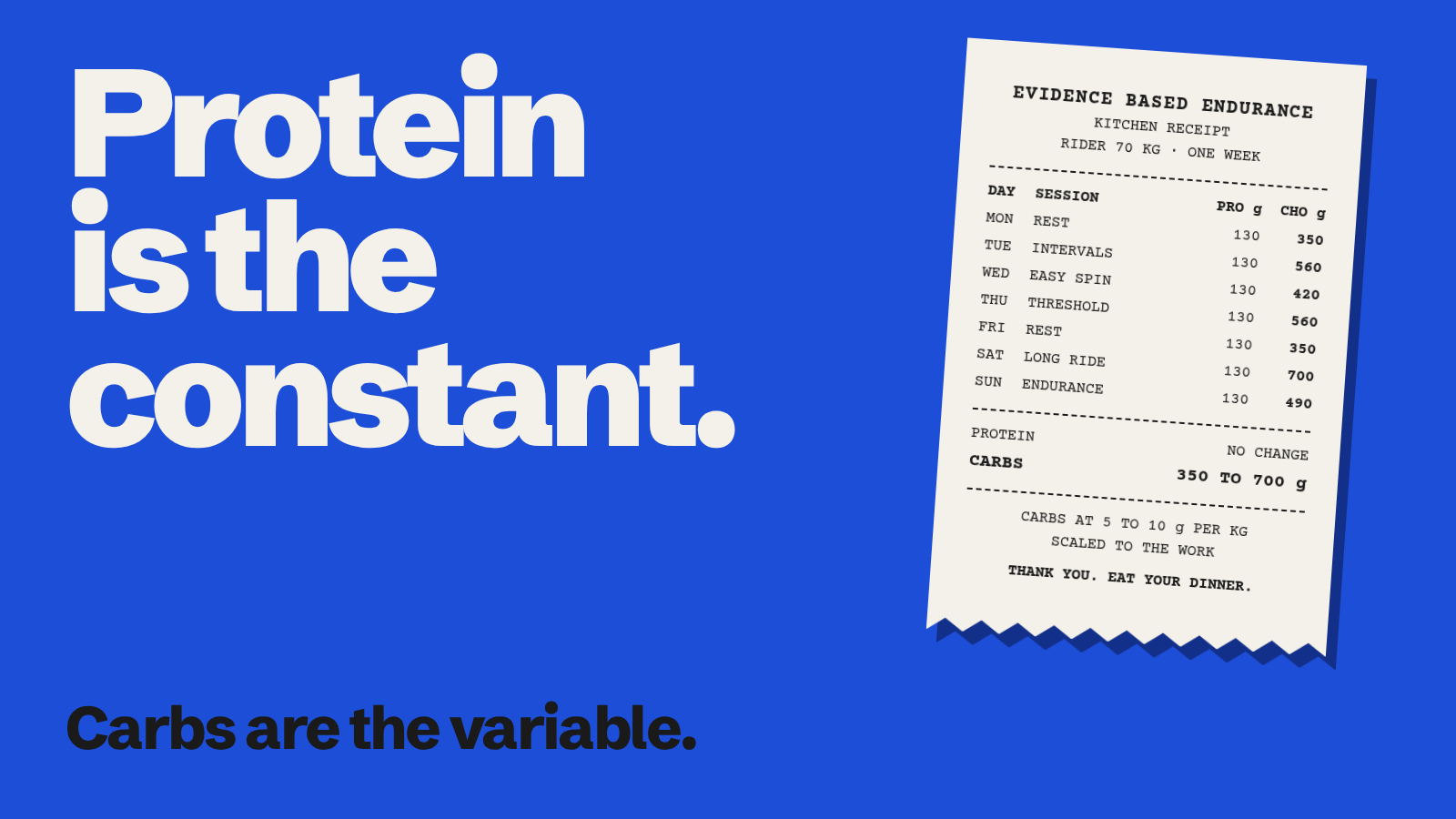
Ask most people what they should eat after training and you'll get the same answer: protein. The shake is in the bag before the shoes are off. The internet has done a fine job on that message, and in fairness, it's correct. Protein repairs muscle, supports adaptation, and most of us who train should be eating a decent amount of it.
Here's the thing though. Your protein needs barely change from one day to the next. Whether you rode for an hour or four, whether it was a recovery spin or a session that left you sitting on the kitchen floor, the target is more or less the same: somewhere around 1.6 to 2 grams per kilo of bodyweight, spread across the day in meals of 20 to 40 grams. Hit that consistently and protein is sorted. It's a constant. You set it once and leave it alone.
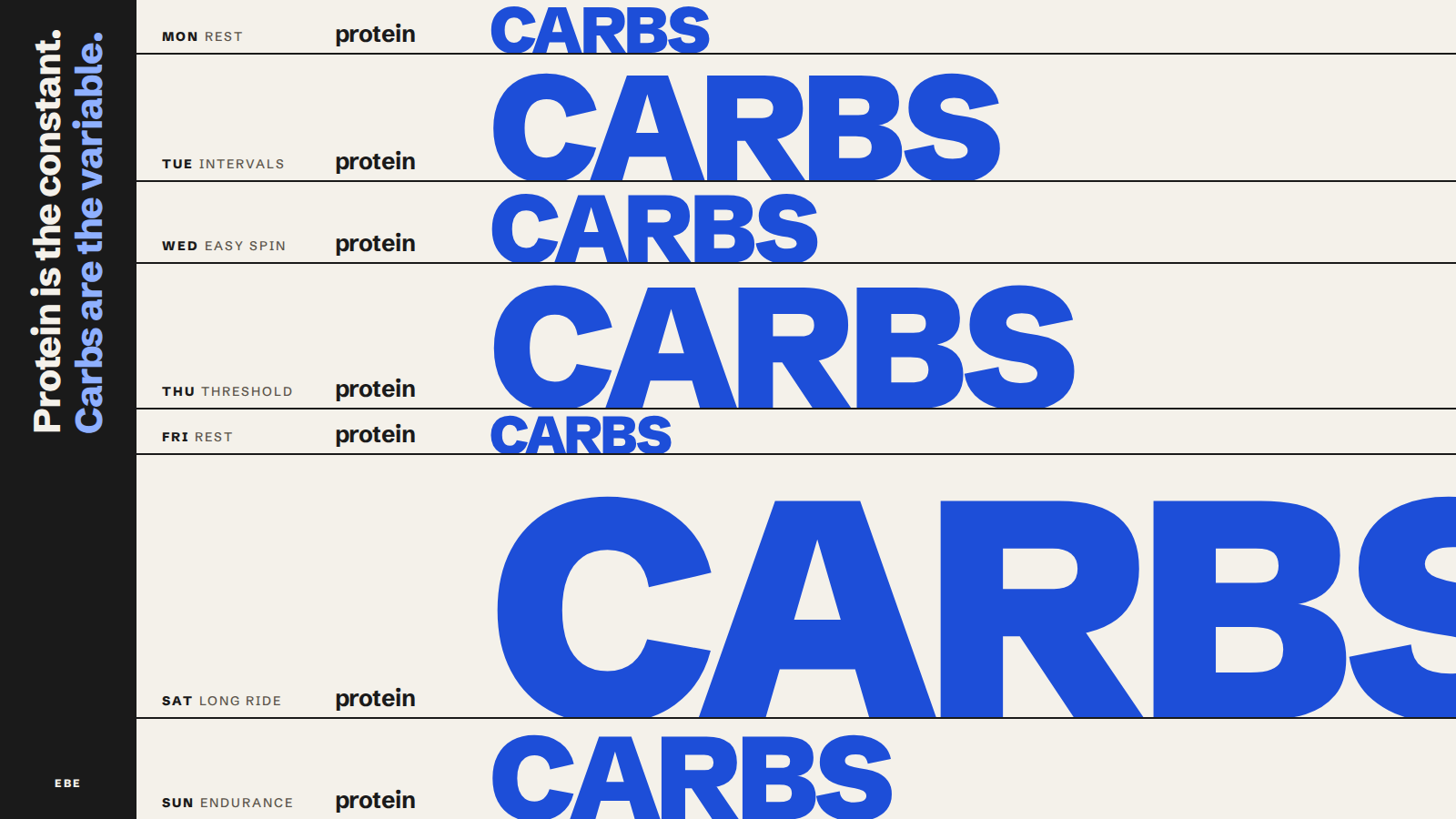
Carbohydrate is a different animal. It's the one thing on your plate that should move up and down with your training, and it's the thing that decides how tomorrow's session goes.
WHY TOMORROW DEPENDS ON TONIGHT
Hard and long endurance training runs on glycogen, the carbohydrate stored in your muscles and liver. You don't have much of it. A good session can empty a large part of the tank, and a big day can nearly drain it. The only thing that refills it is carbohydrate. Protein won't do it. Fat won't do it. And refilling is slow, in the region of 24 hours even when you're eating plenty of carbs, longer when you aren't.
Now look at how most of us actually train. Four, five, six days a week, often with consecutive days. Tuesday evening session, Wednesday morning spin, hard again Thursday. That's under 24 hours between bouts, again and again. A 2025 review in Sports Medicine by Naderi and colleagues looked at precisely this scenario, and the conclusion is plain: getting carbohydrate, protein and fluid right after exercise is critical for holding performance in the next session when recovery is less than a day. Of those three, carbohydrate is the one most people are missing.
Start a session with half a tank and you know what it feels like, even if you've never named it. Heart rate won't come up, the legs feel flat, the numbers you hit last week are suddenly out of reach, and you decide you must be tired or unfit or getting old. Often you're just underfuelled from yesterday.
WHAT THE NUMBERS LOOK LIKE
When the turnaround is short, say an evening session followed by a morning one, the evidence supports around 1 to 1.2 grams of carbohydrate per kilo of bodyweight per hour for the first three or four hours after training. For a 70 kilo rider that's 70 to 85 grams an hour. A big bowl of rice or pasta with dinner, some bread, a bit of fruit and a glass of juice gets you there. It doesn't need to be engineered.
When you have a full day before the next session, the urgency drops and the daily total is what counts. For someone training an hour or so a day, 5 to 7 grams per kilo is a reasonable target. For one to three hours a day, it's 6 to 10. Most recreational athletes who track their food for a few days find they're nowhere near that on their heavy days, usually because they've been told carbs are something to be managed down.
One useful detail from the review: adding protein helps glycogen recovery when carbohydrate intake is below optimal. So if you can't stomach the full carb dose, carbs plus protein together is a good fallback. Which is another way of saying a normal dinner works.
THE PRACTICAL VERSION
Keep your protein steady every day and stop thinking about it. Then scale your carbs to the work. Big day or back to back sessions, eat a lot of them and start soon after you finish. Easy day or rest day, bring them down a bit. That's the whole system.
If you're training most days and you feel like you're always a bit flat, a bit behind, never quite hitting what you know you're capable of, don't go looking for a new training plan or another supplement first. Look at the plate the night before. The fitness might already be there. You just keep turning up without the fuel to show it.
- Naderi A, Rothschild JA, Santos HO, Hamidvand A, Koozehchian MS, Ghazzagh A, Berjisian E, Podlogar T. Nutritional Strategies to Improve Post-exercise Recovery and Subsequent Exercise Performance: A Narrative Review. Sports Medicine. 2025;55:1559 to 1577. doi:10.1007/s40279-025-02213-6